Third time’s the charm: Triangular Self-Translation
DOI:
https://doi.org/10.4000/16za4Keywords:
self-translation, multilingualism, trilingualism, migrant literature, triangular self-translationAbstract
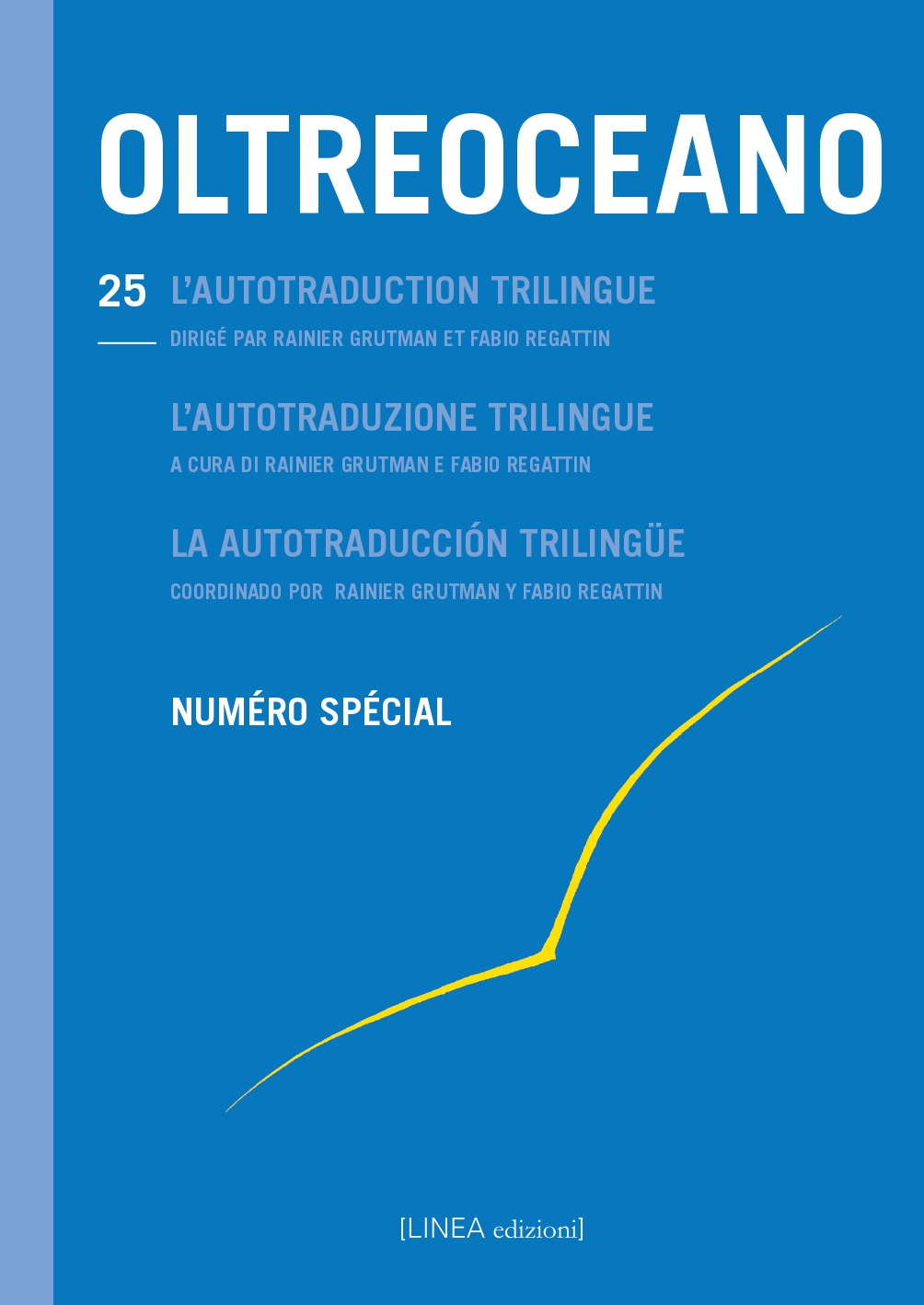
Long considered rare or marginal, literary self-translation is now recognized as a widely practiced phenomenon: hundreds of writers have translated one or more of their own works. This issue of Oltreoceano focuses more specifically on so-called “multidirectional self-translations” (Julio-César Santoyo) that combine three or even more languages, admittedly a less common scenario but one whose vitality is nonetheless attested in the various essays that make up this issue. The resulting overview reveals the richness and diversity of these multilingual practices and argues for a broader understanding of self-translation as an inherently multilingual and multidirectional phenomenon.
While some writers translate an already bilingual source text into a third language, others alternate between different language pairs, depending on the title. However, the most accomplished form of literary trilingualism consists of translating the same text into two other languages. This could be called triangular self-translation, in the sense that each corner (“vertex”) of a triangle is connected to the other two by two lines (“sides.”) It is exemplified by authors such as Laia Fàbregas and Monika Zgustová, as well as Carlo Coccioli, Luigi Donato Ventura, and Felicia Mihali, whose careers showcase the diversity of trajectories involving languages, migrations, and writing practices.
Particular attention is paid to Italy, a profoundly multilingual country where the coexistence of Italian, dialects, and minority languages fosters original forms of writing. Poets like Fernando Bandini and Michele Sovente combine dialect, Italian, and Latin. Gerhard Kofler and Andrea Zanzotto, on the other hand, develop multilingual works where self-translation by and large remains structured by binary relationships.
Trilingual configurations can also be found in Italophone migrant writing, as exemplified by Amelia Rosselli, Francesca Criselli, or Prisca Agustoni. In Canada, writers of Italian immigrant background likewise demonstrate the vitality of these practices: Licia Canton and Gianna Patriarca write and translate across several languages, while Giovanni Costa’s poetry in Italian, French, and English represents a very accomplished case of triangular self-translation.
Downloads
References
Bernardi Perini, G. (2009) : Poeti neolatini tra bilinguismo e trilinguismo [Fernando Bandini e Michele Sovente], in Pianezzola, E. (a cura di), Il latino del Pascoli e il bilinguismo poetico. Venezia: Istituto Veneto di Scienze Lettere ed Arti, p. 13-25.
Bogaro, A. (2010) : Letterature nascoste. Storia della scrittura e degli autori in lingua minoritaria in Italia, prefazione di Tullio De Mauro. Carocci: Roma.
Bramati, A. (2020) : Alba de Céspedes: dall’educazione plurilingue all’autotraduzione : Il caso Sans autre lieu que la nuit / Nel buio della notte, in Regattin F. (a cura di), Autotraduzione: Pratiche, teorie, storie = Autotraduction : Pratiques, théories, histoires. Città di Castello: Emil, p. 69-92.
Brugnolo, F. (2009a) : La lingua di cui si vanta Amore. Scrittori stranieri in lingua italiana dal Medioevo al Rinascimento. Roma: Carocci.
Brugnolo, F., a cura di (2009b) : Scrittori stranieri in lingua italiana dal Cinquecento ad oggi. Padova: Unipress.
Brugnolo, F. (2014) : Italienisch-Deutsch-Italienisch: Gerhard Kofler und die poetische Selbstübersetzung, Zibaldone. Zeitschrift für italienische Kultur der Gegenwart 58, p. 51-70.
Cagidemetrio, A. (2002) : Trilinguismo letterario: il caso americano di Luigi Donato Ventura, in Brugnolo, F. e Orioles, V. (a cura di), Eteroglossia e plurilinguismo letterario. II. Plurilinguismo e letteratura. Roma: Il Calamo, p. 377-388.
Canton, L. (2015) : Se traduire au quotidien, Interfrancophonies 6, p. 87-92. En ligne : https://doi.org/10.17457/IF6_2015/CAN .
Canton, L. (2017) : “Il negozio della lana”, “Ma cinquième année” et “In the Stacks”, in Chircop, K., Arrigo, N. & Bonomo, A. (a cura di), In-Between Spaces: Percorsi interculturali e trans- disciplinari della migrazione tra lingue, identità e memoria. Avellino: Associazione Culturale Internazionale Edizioni Sinestesie, p. 161-181.
Ciminari, S. & Contarini, S., a cura di (2023) : Alba de Céspedes e gli anni francesi. Firenze: Franco Cesati.
De Blasi, N. (2010) : Dialetto (usi letterari del), Enciclopedia dell’Italiano, diretta da Raffaele Simone. Roma: Istituto della Enciclopedia Italiana, p. 363-365. En ligne : https://www.treccani.it/ enciclopedia/usi-letterari-del-dialetto_(Enciclopedia-dell'Italiano)/
Del Río Zamudio, S. (2020), Carlo Coccioli y Piccolo Karma vs Pequeño Karma : autotraducción, Oltreoceano: rivista sulle migrazioni 16, p. 137-148.
De Mauro, T. (2005) : Come parlano gli italiani, Quaderns d’italià 10, p. 133-148.
Di Gianvito, S. (2022) : Nell’officina poetica di Amelia Rosselli. Il plurilinguismo dei Primi Scritti e il ruolo del Diario in tre lingue. Firenze: Franco Cesati.
Ferraro, A. (2014) : Antonio D’Alfonso ou du vertige autotraductif, Tradução em revista 16, p. 42-54. En ligne : https://www.maxwell.vrac.puc-rio.br/23231/23231.PDF
Gentes, E. (2023) : Bibliography of self-translation, 42e livraison, février 2023. En ligne : https://app.box.com/s/52h3hwsqqty5l34j99hmxqlamb4814q0
Grutman, R. (2015) : Francophonie et autotraduction, Interfrancophonies 6, p. 1-17. En ligne : http://interfrancophonies.org/images/pdf/numero-6/1_Grutman_Interfrancophonies_6_2015.pdf
Grutman, R. et Roman, K. (2026) : Littérature jeunesse et autotraduction au Canada contemporain : une première exploration, à paraître dans Strenae : recherches sur les livres et objets culturels de l’enfance (https://journals.openedition.org/strenae/ ).
Lagarde, C. (2023): La autotraducción: un proceso que no cesa, in: Lafarga, F. & Pegenaute, L. (dir.), Planteamientos historiográficos sobre la traducción en el ámbito hispánico. Kassel: Reichenberger, p. 193-214.
Liberti, G.A. (2018) : Cumae di Michele Sovente. Edizione critica e commento, thèse de doctorat, Università degli Studi di Napoli Federico II.
Pasolini, P.P. (1952): Introduzione, in Pasolini, P.P. & Dell’Arco, M. (a cura di), Poesia dialettale del Novecento (con traduzioni a pie di pagina). Parma: Guanda, p. ix-cxix.
Patriarca, G. (2015) : La langue à l’intérieur de mes langues (traduit de l’anglais par Martina Della Casa), Interfrancophonies 6, p. 93-96. En ligne : http://www.interfrancophonies.org/images/pdf/ numero-6/7_Patriarca_Interfrancophonies_6_2015.pdf. Traduction italienne Patriarca, G. (2019) : La trilogia di una lingua (tradotto dall’inglese da Martina Della Casa), in Regattin, F. & Ferraro, A. (a cura di), Gli scrittori si traducono. Città di Castello: Emil, p. 99-101.
Pivato, J. (2020): Self-Translation as Problem for Italian-Canadian Authors. Oltreoceano: rivista sulle migrazioni 16, p. 15-30.
Puccini, P. (2014) : De l’écriture à l’autotraduction : l’histoire migrante de Gens du silence de Marco Micone, Tradução em Revista 16, p. 55-68. En ligne : https://www.maxwell.vrac.puc-rio.br/23239/23239.PDF
Rosei, S. (2013) : Intervista a Licia Canton, scrittrice italo-canadese. En ligne : https://www.societadelleletterate.it/2013/05/intervista-canadese/
Sáenz, M. (1993) : Autor y traductor, Senez: revista de traducción/Itzulpen Aldizkaria 14, p. 103-118. En ligne : https://eizie.eus/es/publicaciones/senez/19930701/saenz
Santi, F. (2013) : Bilinguismo e mediolatinità. Il caso di Ramon Llull autotraduttore, in Ceccherelli, A., Imposti, G.E. & Perotto, M. (a cura di), Autotraduzione e riscrittura. Bologna : Bononia University Press, p. 241-252.
Santoyo, J.-C. (2005) : Autotraducciones: una perspectiva histórica, Meta 50(3), p. 858-867.
Santoyo, J.-C. (2013) : Esbozo de una historia de la autotraducción, in Lagarde, Ch. & Tanqueiro, H. (dir.), L’autotraduction aux frontières de la langue et de la culture. Limoges : Lambert-Lucas, p. 23-35.
Santoyo, J.-C. (2015) : Consideraciones acerca del estatus actual de la autotraducción en la Península Ibérica, Glottopol 25, p. 47-58.
Sciarrino, E. (2015) : Traduire à quatre mains : le cas d’Amelia Rosselli, Transalpina : études italiennes 18, p. 79-92.
Sciarrino, E. (2016) : Le plurilinguisme en littérature. Le cas italien. Paris : Éditions des Archives contemporaines.
Tanzmeister, R. (2010) : Literarische Mehrsprachigkeit und Selbstübersetzung am Beispiel des dreisprachigen Schriftstellers Carlo Coccioli, in Cichon, P. et al. (eds.), Sprachen – Sprechen – Schreiben. Blicke auf Mehrsprachigkeit. Georg Kremnitz zum 65. Geburtstag. Wien: Praesens, p. 225-276.
Van Bolderen, T. (2021) : Literary Self-translation and Self-translators in Canada (1971-2016): A large-scale Study, thèse de doctorat, Université d’Ottawa.
Van Bolderen, T. (2022): The Spanish Imposition: Literary Self-translation into and out of Spanish in Canada (1971-2016), Mutatis Mutandis. Revista Latinoamericana de Traducción 15(1), p. 130-151. DOI: https://doi.org/10.17533/udea.mut.v15n1a08
Van Bolderen, T. (2024): Trilingual Literary Self-translation: An Interview with two Montreal Writers, Hugh Hazelton and Alejandro Saravia. Journal of Literary Multilingualism 2(1), p. 130-140. DOI: https://doi.org/10.1163/2667324x-20240108
Wanner, Adrian (2020): The Bilingual Muse. Self-translation among Russian Poets. Evanston: Northwestern University Press.
Downloads
Published
How to Cite
Issue
Section
License
Copyright (c) 2026 Linea Edizioni

This work is licensed under a Creative Commons Attribution-NonCommercial-ShareAlike 4.0 International License.
The authors undertake to comply with the following conditions, which are considered accepted at the time of submission of their contributions.
The sending of a text implies that it is unpublished and not submitted to be published elsewhere.
1. If accepted, the author shall confer on the publisher the right to publish and distribute it both in paper form and in the online electronic edition. The published articles will be downloadable and made available in open access.
2. Provided that it correctly indicates that the first publication took place in the journal Oltreoceano. Rivista sulle migrazioni the author has the right to: a) reproduce the article in separate extracts or collected in a volume; b) publish the article on their personal website or teaching site provided that these sites are of a non-commercial nature; c) deposit the article in online archives of a non-commercial nature, linked to the institution they belong to or as part of projects for the non-commercial dissemination and open access of scientific works.
The use of contributions by third parties, for commercial or otherwise unauthorized purposes, is not allowed. The publisher declines all responsibility for the unauthorized use of the material published in the journal.