Regimes of Visibility and Forms of Memory
DOI:
https://doi.org/10.4000/15rcuKeywords:
iconotext, archives/counter-archives, migration, testimony, intermedialityAbstract
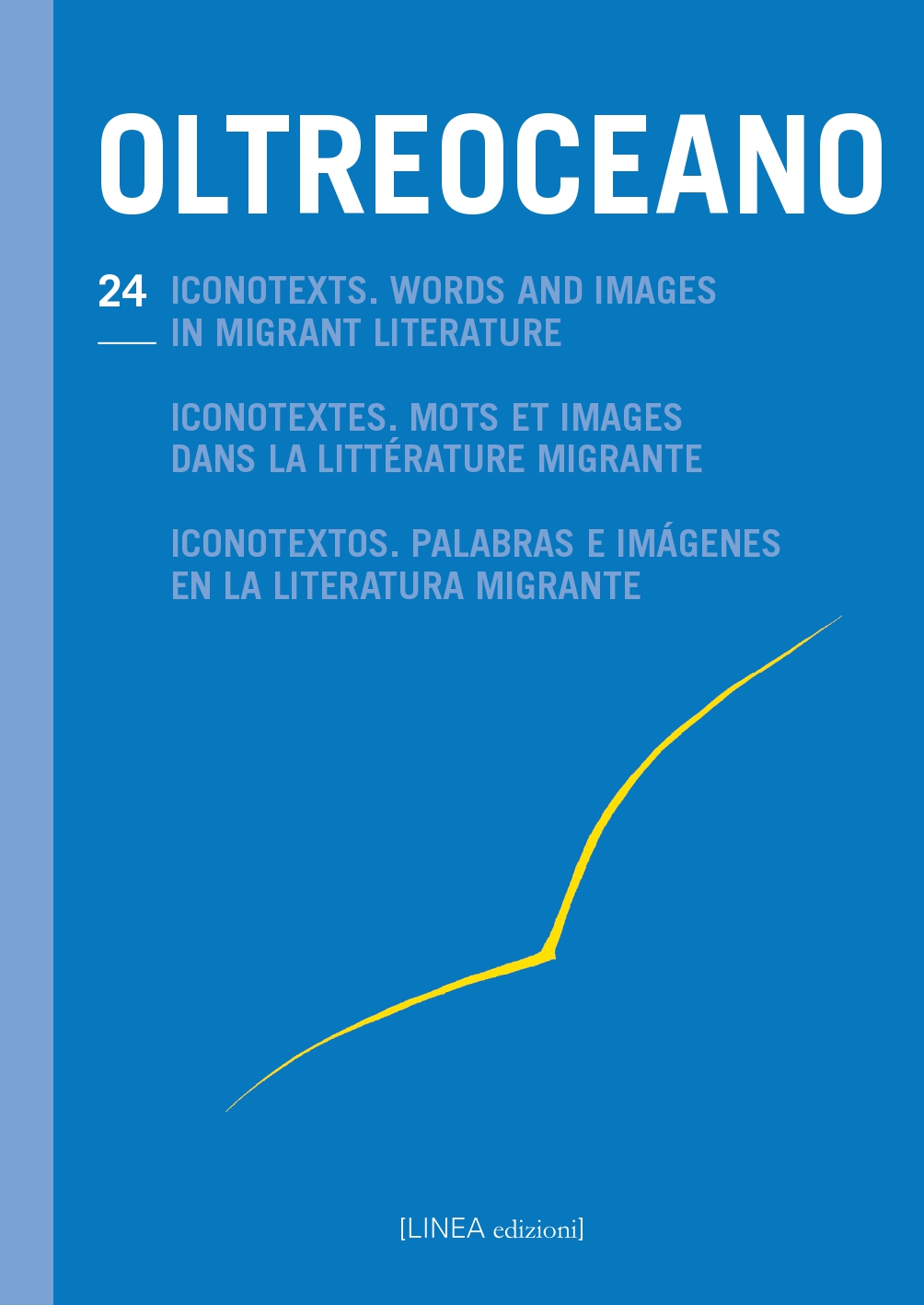
This issue investigates the iconotext as a device in which words and images do not simply add up, but co-produce meaning through friction, montage, ellipsis, and paratextual thresholds. Against the backdrop of the visual turn, sixteen contributions—grouped by linguistic areas (Anglophone studies on the United States; Francophone studies on Québec, Lebanon, and the Antilles; studies on Spanish America)—are presented as thematic constellations that cut across geographical and disciplinary boundaries.
The first constellation foregrounds devices, the page, and materiality: genealogies of phototext and migrant writing, editorial practices (illustrated editions and magazines), and poetics in which photography becomes a model of attention and viewpoint. The second constellation focuses on archives, counter-archives, and the politics of visibility: photographic documents are questioned as sites of power, where race, postcolonial histories, and war require strategies of intervention, slowing down, and anti-spectacular ethics. The third constellation addresses migration, autobiography, and testimony: graphic memoirs, phototexts, and wordless narratives show how displacement also works as a form (discontinuity, sequencing, ellipsis) and how silence can operate as a mode of care for trauma. Taken together, the essays propose a shared methodological compass: a “double-entry” reading that combines attention to material features (supports, layout, paratexts, rhythm) with an analysis of pragmatic effects (what images enable, postpone, contradict, or keep unsaid).
Downloads
References
Barthes, R. (1964): Rhétorique de l’image. Communications, 4, pp. 40-51.
Barthes, R. (1980): La Chambre claire. Note sur la photographie. Paris: Cahiers du cinéma, Gallimard & Seuil.
Benjamin, W. (2000): L’opera d’arte nell’epoca della sua riproducibilità tecnica, 1955. E. Filippini (Trad.). Torino: Einaudi.
Cometa, M. (2016): Fototesti. Letteratura e cultura visuale. In M. Cometa & R. Coglitore (Eds.), Fototesti. Letteratura e cultura visuale (pp. 69-115). Macerata: Quodlibet.
Foster, H. (2004): An Archival Impulse. October, n. 110, pp. 3-22.
Hirsch, M. (1997): Family Frames: Photography, Narrative and Postmemory. Cambridge: Harvard University.
Louvel, L. (2011): Poetics of the Iconotext. Surrey: Ashgate.
Mitchell, W. J. T. (1994): Picture Theory. Chicago & London: University of Chicago.
Montandon, A. (Ed.) (1990): Iconotextes. Paris: Ophrys.
Nachtergael, M. (2012): Les Mythologies individuelles. Récit de soi et photographie au 20e siècle. Amsterdam & New York: Rodopi.
Ortel, P. (2002): La littérature à l’ère de la photographie. Enquête sur une révolution invisible. Nîmes: Jacqueline Chambon.
Pedri, N. (Ed.) (2015): The Narrative Functions of Photography in Comics. Numéro spécial de Image & Narrative, vol. 16 (2). Tiré de https://www.imageandnarrative.be/index.php/imagenarrative/issue/view/52 (Consulté le 05/01/2026).
Sontag, S. (2004): Sulla fotografia. Realtà e immagine nella nostra società, 1977. E. Capriolo (Trad.). Torino: Einaudi.
Sperti, V. (2005): Fotografia e romanzo. Napoli: Liguori.
Wagner, P. (1995): Reading Iconotexts. From Swift to the French Revolution. London: Reaktion Books.
Downloads
Published
How to Cite
Issue
Section
License
Copyright (c) 2026 Linea Edizioni

This work is licensed under a Creative Commons Attribution-NonCommercial-ShareAlike 4.0 International License.
The authors undertake to comply with the following conditions, which are considered accepted at the time of submission of their contributions.
The sending of a text implies that it is unpublished and not submitted to be published elsewhere.
1. If accepted, the author shall confer on the publisher the right to publish and distribute it both in paper form and in the online electronic edition. The published articles will be downloadable and made available in open access.
2. Provided that it correctly indicates that the first publication took place in the journal Oltreoceano. Rivista sulle migrazioni the author has the right to: a) reproduce the article in separate extracts or collected in a volume; b) publish the article on their personal website or teaching site provided that these sites are of a non-commercial nature; c) deposit the article in online archives of a non-commercial nature, linked to the institution they belong to or as part of projects for the non-commercial dissemination and open access of scientific works.
The use of contributions by third parties, for commercial or otherwise unauthorized purposes, is not allowed. The publisher declines all responsibility for the unauthorized use of the material published in the journal.